
How to Build a Telegram Account Creator (Complete System Guide)
In this article, learn how to build a Telegram account creator system step by step, from setup to scaling, so you can build a stable, fully scalable system successfully.
Introduction
A Telegram account creator is not just a script or standalone tool. it is a structured, multi-layered system designed to operate as a complete workflow. It combines environment setup, proxy and IP control, number sourcing, verification handling, execution logic, session management, and post-creation processes, where each layer directly impacts overall success rate and system stability.
Most failures in Telegram account creation occur when these components are handled separately without coordination. Weak proxy isolation, low-quality numbers, delayed OTP processing, or inefficient execution strategies create compounding issues that reduce efficiency and increase failure rates. Stability is achieved by understanding how each layer connects and ensuring the entire system runs in a controlled and predictable manner.
This guide breaks down how to build a Telegram account creation architecture from the ground up. Each section maps a specific part of the architecture and connects it to detailed resources, allowing a shift from manual, inconsistent methods to a structured, repeatable, and scalable system designed for consistent results.
For cases where building each layer is not required, an alternative pre-configured system approach is outlined later in this guide.
- System Overview
- Environment Setup
- Proxy & IP Isolation
- Number Sourcing & SMS Layer
- OTP Handling System
- Execution Strategy
- Scaling Infrastructure
- Failure Handling & Risk Control
- Post-Creation Systems
- Session Management & Storage
- Performance Monitoring & Optimization
Step-by-Step System Architecture
This section breaks down each layer of the Telegram account creation system in a structured way. Instead of viewing the process as a single flow, each step is analyzed based on its role, impact on success rate, and dependency on other components.
The goal is to show how the system operates as a connected architecture, where every layer influences the next. By understanding these relationships, the entire workflow can be built, optimized, and scaled with predictable results.
Each step below focuses on a specific part of the system and explains how it contributes to overall stability, efficiency, and execution control.
1. System Overview: How Telegram Account Creation Works
Role in the System: Defines the complete execution pipeline that governs how accounts move from initialization to final session storage. It establishes order, control, and dependency across all system layers.
Why It Matters: A structured pipeline ensures each stage executes in coordination. Without it, components behave independently, leading to inconsistent results and unstable scaling.
What Breaks If Ignored:
- OTP arrives but cannot be applied due to a timing mismatch
- Numbers are consumed without successful registration
- conflicts occur between parallel instances
- Scaling becomes unstable due to unsynchronized steps
How It Connects:
- starts with Environment Setup (execution base)
- flows into Number Sourcing → OTP/Email Verification → Registration
- ends in Session Management & Storage
All other steps operate within this pipeline
Implementation Direction:
Map the full lifecycle before building:
- define the exact sequence of actions
- Assign clear input/output for each stage
- ensure controlled transitions between steps
Avoid treating any component as standalone.
Learn More About Flow & Structure: For a broader view of how all components connect, see:
→ Complete account creation workflow (step-by-step execution flow).
→ TG Account creation system architecture.
2. Environment Setup
Role in the System: Provides the execution environment where account creation runs. It simulates real device behavior while ensuring each instance operates independently.
Why It Matters: Ensures strict environment isolation so each instance operates independently without interference.
What Breaks If Ignored:
- Accounts get linked due to shared device fingerprints
- execution becomes unstable under parallel load
- Resource conflicts cause crashes or slowdowns
- Inconsistent behavior across instances reduces the success rate
How It Connects:
- follows System Overview as the execution base
- directly supports Proxy & IP Isolation (each instance needs separate routing)
- impacts Execution Strategy and Scaling Infrastructure
All runtime operations depend on this layer.
Implementation Direction:
- Use Android emulators to simulate real devices
- ensure device-level separation for each instance
- control CPU, RAM, and resource allocation per environment
- maintain consistency across all instances
Avoid running multiple accounts in a shared environment.
→ Emulator Automation Setup Guide.
3. Proxy & IP Isolation
Role in the System: Controls the network identity of each instance by assigning separate IP addresses, ensuring every account operates as an independent entity.
Why It Matters:Defines a unique network identity for each instance, preventing linkage and maintaining verification reliability.
What Breaks If Ignored:
- Multiple accounts get linked and restricted
- Verification requests get blocked or flagged
- success rate drops due to shared IP patterns
- scaling fails as detection increases with volume
How It Connects:
- depends on the Environment Setup for per-instance configuration
- directly affects Number Sourcing & OTP Handling (verification reliability)
- impacts Execution Strategy and overall system stability
All network-level behavior is controlled through this layer.
Implementation Direction:
- Assign a unique proxy to each emulator instance
- Use stable and consistent IP routing
- Avoid shared or reused IPs across multiple accounts
- maintain geographic and behavioral consistency where required
Improper IP handling cannot be compensated by other layers.
→ Android emulator proxy setup for automation Guide.
4. Number Sourcing & SMS Layer
SMS API Integration
The system requires a consistent source of phone numbers. SMS APIs act as the interface between your system and number providers. Efficiency depends on response time, availability, and integration stability.
To understand the integration structure and API handling:
→ SMS API integration for automated account creation (system interface layer)
SMS Providers
Not all providers behave the same. Differences in delivery speed, reuse patterns, and success rate directly affect account creation.
Provider selection is a core variable in system performance.
→ SMS providers for Telegram account creation
Virtual Number Quality
The quality of the number directly affects verification success or failure. Low-quality numbers increase retries and reduce efficiency.
Evaluation methods and cost-performance balance are critical for maintaining consistency.
→ Virtual number quality (cost vs success analysis).
Email Verification Layer
Some Telegram registration flows include email-based verification alongside SMS. This adds an additional validation step that must be handled within the system.
To understand how automated email verification integrates into the signup process:
→ Telegram email verification system
Role in the System: Supplies phone numbers and manages OTP delivery, acting as the input and verification gateway for account creation.
Why It Matters: Determines input reliability, where number quality and OTP delivery directly impact verification success.
What Breaks If Ignored:
- OTP delivery delays interrupt the registration flow
- Numbers fail verification due to reuse or low trust score
- API instability leads to missed or expired OTPs
- Inconsistent supply reduces execution efficiency
How It Connects:
- depends on Proxy & IP Isolation for successful verification requests
- feeds directly into the OTP Handling System
- impacts Execution Strategy through timing and availability
This layer controls both input quality and verification reliability.
Implementation Direction:
- integrate stable SMS APIs for automation
- Select providers based on delivery speed and success rate
- filter and test the number quality before scaling
- maintain consistent API response handling
Number sourcing quality directly defines system performance.
5. OTP Handling System
Role in the System: Processes verification by capturing, validating, and applying OTPs, acting as the transition between number allocation and account activation.
Why It Matters: OTP handling controls timing and accuracy in the verification stage. Delays or mismatches directly interrupt the flow and reduce successful registrations.
What Breaks If Ignored:
- OTP expires before being applied
- incorrect or mismatched OTP leads to verification failure
- retries increases due to delayed processing
- account creation flow stalls between number allocation and activation
How It Connects:
- depends on the Number Sourcing & SMS Layer and email verification systems for handling multi-step verification flows
- directly enables account registration in the pipeline
- impacts Execution Strategy through timing and retry behavior
This layer controls the transition from input (number) to activation (account).
Implementation Direction:
- automate OTP capture from SMS APIs
- Validate OTP before applying to avoid mismatches
- minimize latency between receiving and submitting OTP
- Implement retry logic with controlled timing
Delays at this stage directly reduce system efficiency.
→ structure of the Automated OTP system flow (end-to-end pipeline)
→ Failure patterns are analyzed in the Telegram OTP failures (causes and breakdown analysis)
→ Optimization strategies are covered in OTP failure reduction and retry efficiency Ways.
6. Execution Strategy
Execution Models (Batch vs Continuous)
The way tasks are scheduled defines how accounts are created over time. Batch execution groups actions, while continuous execution spreads them across a steady flow.
This defines how requests are distributed and timed.
→ Batch vs continuous execution models
Scaling Approach (Sequential vs Parallel)
Execution can be handled one-by-one (sequential) or across multiple instances simultaneously (parallel).
This determines how fast the system grows and how the load is distributed.
→ Sequential vs parallel account creation scaling behavior.
Concurrency Structure (Multi-threading & Multi-instance)
Concurrency defines how many tasks run at the same time within and across environments.
It impacts throughput, system load, and coordination between processes.
→ Multi-threading and multi-instance systems (concurrency structures).
Role in the System: Controls how account creation tasks are scheduled, distributed, and executed across the system.
Why It Matters: Execution strategy directly affects speed, detection risk, and system stability. Poor execution patterns create predictable behavior that increases failure rates.
What Breaks If Ignored:
- Requests become predictable and get flagged
- System overload causes crashes or slowdowns
- Inefficient scheduling reduces throughput
- scaling fails due to a lack of coordination between tasks
How It Connects:
- depends on the OTP Handling System for timing-sensitive execution
- works with Scaling Infrastructure to expand capacity
- influenced by the environment setup and resource limits
This layer defines how efficiently the system operates.
Implementation Direction:
- choose execution model based on stability vs speed requirements
- balance sequential and parallel processing to avoid overload
- control timing intervals between actions
- Manage concurrency to match system capacity
Execution control determines both performance and detection resistance.
7. Scaling Infrastructure
Multi-Instance Environments
Scaling requires running multiple isolated environments in parallel while maintaining control over execution.
This ensures capacity increases without merging behaviors between instances.
→ Multi-instance environments for scaling.
Performance Optimization
As the instance count increases, system resources become a limiting factor. Proper optimization prevents lag, crashes, and performance drops.
Resource balance is critical for stable scaling.
→ Running multiple instances without system lag (performance handling).
Structured Scaling Systems
Scaling must follow a defined structure, not random expansion. Controlled growth maintains stability and predictability.
This includes managing load distribution, execution timing, and system coordination.
To understand structured scaling with an example, see:
→ Telegram account creation using Hero SMS (structured scaling system)
Role in the System: Expands system capacity by increasing the number of environments and processes while maintaining stability and control.
Why It Matters: Scaling without structure leads to instability. Proper infrastructure ensures increased volume does not reduce success rate or system performance.
What Breaks If Ignored:
- system crashes under high load
- performance drops as instances increase
- Resource conflicts reduce execution efficiency
- success rate declines due to uncontrolled expansion
How It Connects:
- depends on the execution strategy for task distribution
- relies on the Environment Setup for isolated instances
- impacts Failure Handling & Risk Control due to increased volume
This layer defines how far the system can scale without breaking.
Implementation Direction:
- Increase instances gradually with controlled resource allocation
- Monitor CPU, RAM, and system load continuously
- synchronize execution across environments
- avoid uncontrolled scaling without performance validation
Scaling must preserve stability while increasing capacity.
8. Failure Handling & Risk Control
System-Level Failures
Failures follow identifiable patterns related to scaling, execution flow, and system coordination. Understanding these patterns allows controlled adjustments instead of repeated breakdowns.
To analyze failure behavior at scale:
→ TG Account creation failures at scale (system-level breakdown)
IP-Related Restrictions
IP behavior is a major factor in detection. Improper routing, reuse, or abnormal patterns lead to bans and restrictions.
This directly impacts account survival and verification success.
→ IP behavior and proxy isolation (understand IP-based restrictions)
Operational Mistakes
Incorrect configuration, poor timing, and mismanaged resources reduce overall success rate.
These errors compound as the system scales.
→ Identify the Common Telegram account creation mistakes.
Safe Execution Limits
There are thresholds for how many accounts can be created within a given timeframe.
Exceeding these limits increases detection risk and failure rates.
→ Daily Telegram account creation limits (safe thresholds)
Role in the System: Monitors, identifies, and controls failure patterns to maintain system stability and reduce detection risk.
Why It Matters: Without failure control, issues repeat and compound, reducing the success rate and causing large-scale losses during execution.
What Breaks If Ignored:
- Repeated failures without correction
- increased account bans and restrictions
- resource waste due to uncontrolled retries
- scaling becomes unstable due to unaddressed risks
How It Connects:
- depends on Scaling Infrastructure, where failures increase with volume
- influenced by Proxy & IP Isolation and Execution Strategy
- supports Performance Monitoring & Optimization for continuous improvement
This layer ensures the system adapts instead of collapsing under failure.
Implementation Direction:
- track failure patterns across all stages
- adjust IP behavior, timing, and execution based on feedback
- enforce limits to avoid triggering detection systems
- Reduce retries by fixing root causes instead of repeating actions
Failure control defines long-term system stability.
9. Post-Creation Systems
Account Warmup
Newly created accounts require controlled activity after creation to appear natural and avoid restrictions.
This includes gradual usage patterns instead of immediate heavy actions.
→ Telegram account warmup process (safe usage after creation)
Access Continuity
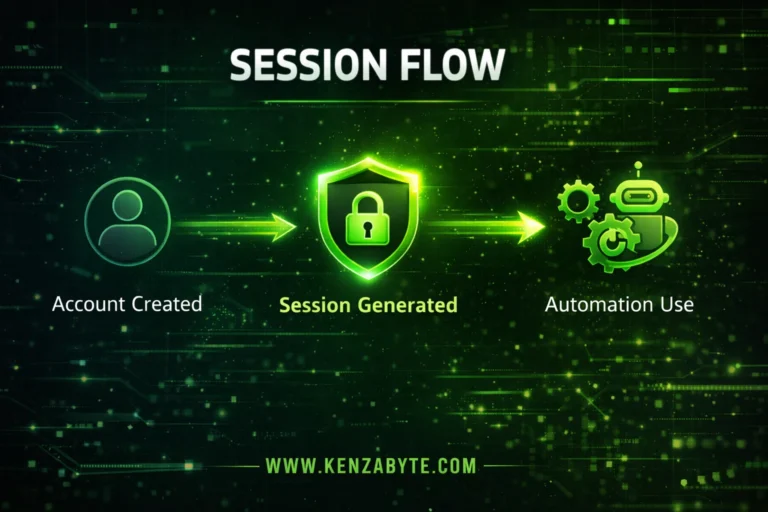
After creation, maintaining access and controlling sessions is required to keep accounts usable over time.
Improper handling leads to session loss or account instability.
→ Telegram session management (post-creation access control)
Role in the System: Maintains account stability and usability after creation by controlling behavior and preserving access.
Why It Matters: Account creation alone does not guarantee usability. Without post-creation handling, accounts get restricted, flagged, or lose functionality.
What Breaks If Ignored:
- Accounts get limited or banned shortly after creation
- Abnormal activity patterns trigger detection
- Session loss leads to unusable accounts
- long-term usability declines despite successful creation
How It Connects:
- follows Account Registration as the next stage
- works with Session Management & Storage for access continuity
- influenced by Failure Handling & Risk Control for safe usage patterns
This layer determines whether created accounts remain usable.
Implementation Direction:
- Apply gradual activity patterns after account creation
- avoid immediate high-volume actions
- Maintain consistent session usage across systems
- Monitor account behavior over time
Post-creation handling defines long-term account survival.
10. Session Management & Storage
Session Formats (String vs TData)
Sessions define how account access is stored and reused across systems. Different formats offer different levels of portability, security, and compatibility.
Choosing the correct format affects how sessions are handled in automation.
→ Telegram session string vs TData (storage format Comparison)
Framework-Level Differences
Session handling varies depending on the framework used. Each system manages authentication, storage, and reuse differently.
This impacts how sessions are created, stored, and accessed programmatically.
→ Telethon vs Pyrogram session (framework framework-level comparison)
Role in the System: Maintains persistent access to created accounts by storing and managing session data across the system.
Why It Matters: Sessions act as the access layer. Without proper handling, accounts cannot be reused, controlled, or scaled effectively.
What Breaks If Ignored:
- loss of access to created accounts
- session conflicts when reused incorrectly
- Inability to manage accounts across systems
- increased need for repeated logins or re-verification
How It Connects:
- follows Post-Creation Systems for long-term usability
- supports Execution Strategy for account reuse
- impacts Performance Monitoring & Optimization through session tracking
This layer ensures continuity of access and control.
Implementation Direction:
- choose session format based on system requirements
- store sessions securely and consistently
- avoid reuse conflicts across multiple instances
- Maintain structured storage for easy access and scaling
Session handling defines control over created accounts.
11. Performance Monitoring & Optimization
Continuous observation is required to understand how the system behaves under different conditions and loads.
Metrics expose bottlenecks, delays, and failure patterns that are not visible during execution.
→ Automation system performance tracking and stabilization methods.
Role in the System: Monitors system behavior and performance to detect issues, measure efficiency, and guide optimization.
Why It Matters: Without monitoring, failures remain hidden until they scale into major breakdowns. Tracking ensures problems are identified early and corrected systematically.
What Breaks If Ignored:
- Hidden bottlenecks reduce system efficiency
- failures accumulate without detection
- resource usage becomes unbalanced
- scaling leads to instability without visibility
How It Connects:
- depends on the scaling infrastructure and Execution Strategy for performance data
- supports Failure Handling & Risk Control by identifying patterns
- impacts all layers through continuous feedback and adjustment
This layer provides visibility across the entire system.
Implementation Direction:
- track key metrics such as success rate, latency, and failure frequency
- Monitor resource usage across environments
- Identify bottlenecks and adjust execution accordingly
- continuously refine system performance based on data
Optimization depends on accurate and consistent monitoring.
System Dependencies Summary
The system operates as a dependency chain where each layer relies on the previous one. Failure in early stages propagates forward, reducing the overall success rate.
Each component does not function in isolation. Environment setup affects IP behavior, IP behavior affects number verification, number quality affects OTP success, and OTP handling affects final account creation.
Stability is achieved by maintaining control across all connected components rather than optimizing individual parts separately.

Alternative Approach: Pre-Configured System
This section explains a different way to approach the system. Instead of building each layer step by step, a pre-configured system combines all required components into one structured workflow.
This includes environment setup, proxy handling, number sourcing, OTP processing, and execution logic, all arranged to work together.
Integrated Workflow Structure
In a pre-configured system, all parts are already connected and aligned.
- Each step follows a defined sequence
- Dependencies between layers are already handled
- execution flow is pre-structured instead of being manually created
This removes the need to connect and test each component separately.
When This Approach Is Used
This approach is used in situations where:
- Building each component manually is not required
- Integration between multiple layers becomes complex
- Consistent execution is more important than customization
- Reducing setup time is necessary
The focus shifts from building the system to operating it.
To understand how such systems are structured and operate in practice:
Why This Approach Matters
A pre-configured system reduces:
- setup complexity
- integration errors between components
- time spent connecting multiple layers
It also improves:
- execution consistency
- system stability
- repeatability of results
Conclusion
Building a Telegram account creator is an exercise in system design, not tool assembly. What determines outcomes is not any single component, but how consistently each layer behaves in relation to the others under real execution conditions.
A working setup can still fail when coordination breaks. Timing mismatches, identity overlap, input inconsistency, or uncontrolled scaling do not appear as isolated issues. they surface as patterns across the system. Stability comes from reducing variation at every stage and maintaining predictable behavior as volume increases.
The architecture defined in this guide provides a controllable framework. It allows execution to move from trial-based results to measured, repeatable outcomes where each stage produces expected input for the next. This is what enables both reliability and scalability without introducing instability.
Whether the system is built manually or operated through a pre-structured approach, the underlying requirement remains the same: maintain alignment across all layers, control execution conditions, and ensure that the system behaves consistently under load.

Arabella Montrose
I have over 8 years of experience in content writing, specializing in Telegram automation, user-friendly tools, and social media marketing services. I work closely with the Kenza Byte team to ensure every article I write is accurate, clear, and genuinely helpful for users and businesses focused on digital growth.